
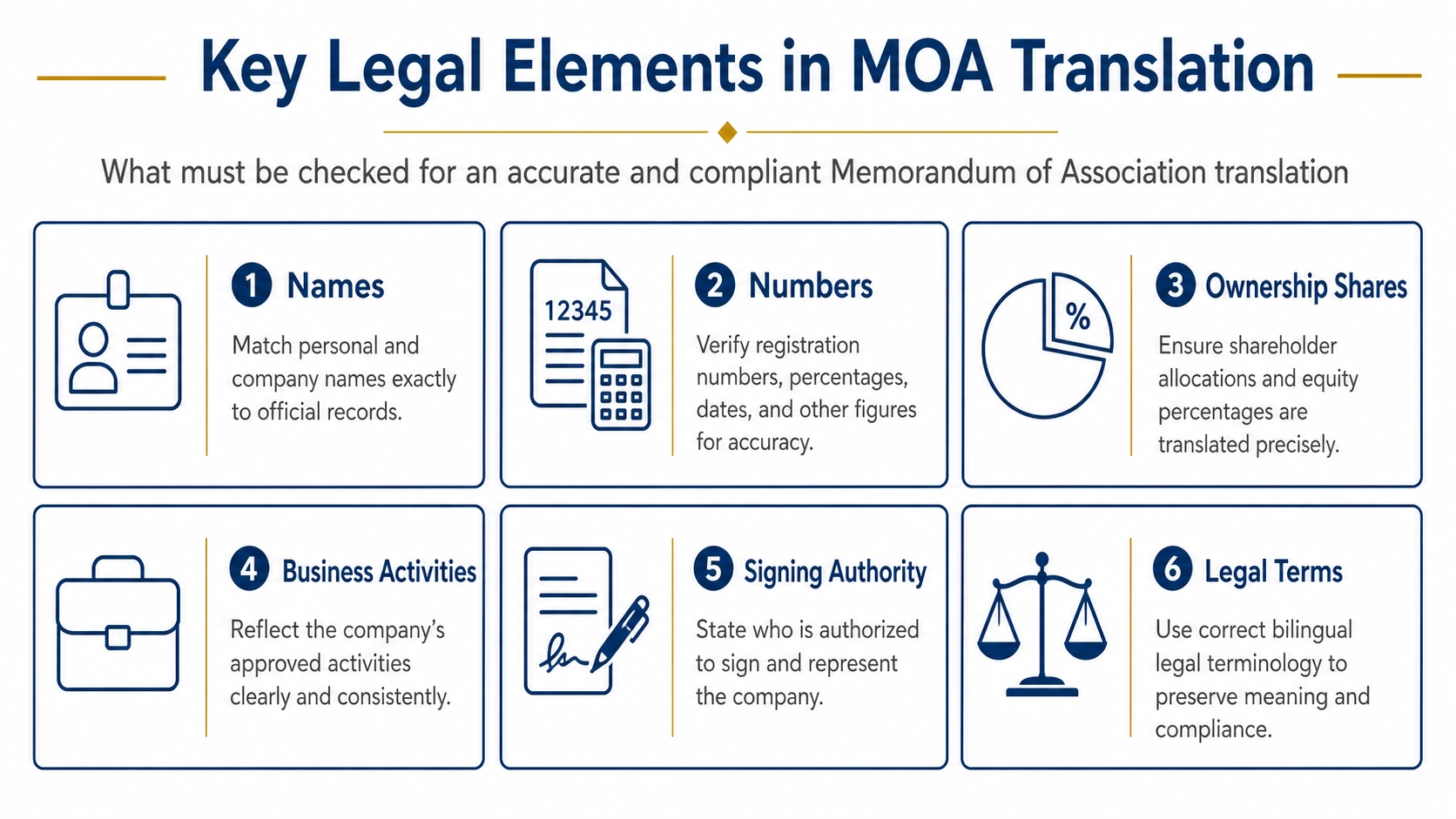
TL;DR: MOA translation in the UAE should be clear, but it should never change the legal meaning of the original document. Names, numbers, ownership details, signing powers, business activities, dates, and legal terms need careful handling because they can affect licensing, banking, company updates, and official review.
Key Takeaways
The UAE has mainland companies, free zone entities, foreign branches, joint ventures, local sponsors, and international investors, so MOAs often move between Arabic, English, and other languages. Once translated, an MOA may be reviewed by banks, licensing authorities, advisers, investors, shareholders, and government departments against official company records.
This is where small mistakes can create big problems. A slightly different spelling of a shareholder’s name, a missing approval requirement, or a changed business activity can lead to questions, corrections, and repeated back-and-forth. Careful translation helps prevent those delays.
Shareholder, partner, manager, director, and authorised representative names must match official records. For individuals, use the spelling shown on passports, Emirates IDs, visas, powers of attorney, or past legal files. For corporate shareholders, follow the commercial license, incorporation papers, or board resolution to avoid confusion during document checks.
The same rule applies to passport numbers, Emirates ID numbers, nationalities, addresses, license numbers, registration numbers, and roles. These details should not be simplified to make the document look cleaner.
In an MOA, identity details are part of the legal record. They show who owns the company, who represents it, and who has rights or obligations under the agreement.
Share capital, contribution amounts, share values, number of shares, ownership percentages, and profit shares must match the original document. Even one misplaced decimal point or inconsistent percentage can change how ownership is understood.
Currency details must stay consistent and easy to follow. If the MOA mentions UAE dirhams, US dollars, paid-up capital, unpaid capital, in-kind contributions, or shareholder obligations, the translation should repeat them clearly. These figures affect ownership and financial rights, so they should never be rounded, shortened, or casually rewritten.
The business activities section shows what the company is allowed to do, so it must stay close to the original wording. It may be checked against the trade license or free zone activity list. A translator should not make activities sound broader, newer, or more appealing, because official terms can carry different meanings.
One changed word can affect the perceived scope of the company’s work. That matters during licensing, banking, contract review, due diligence, and investor checks.
The translation should tell the reader what the original document says, not what the translator thinks it should say.
Signing authority clauses are some of the most important parts of an MOA. They explain who can act for the company and under what conditions.
These clauses may name managers, directors, partners, shareholders, board members, or authorized representatives. They may also say whether authority is individual, joint, limited, or subject to approval.
Small words matter here. Terms such as solely, jointly, severally, subject to approval, and within the limits of can change the meaning of the clause.
If the original says two people must sign together, the translation must not make it sound like one person can sign alone. If authority is limited, the limit must remain clear.
Profit, loss, and liability clauses show how money, risk, and responsibility are shared between shareholders or partners. These parts should never be translated based on guesswork. In some MOAs, profit distribution is different from ownership percentage, so assuming they are the same can mislead the reader.
Liability wording also needs to stay firm. If a clause talks about limited liability, guarantees, shareholder duties, or partner responsibility, the translation should keep the same meaning and level of detail. It should not make the clause sound broader, softer, or less serious than the original.
MOAs often explain how shares can be sold, transferred, inherited, withdrawn, or passed to new partners. These rules matter during restructuring, disputes, investment talks, or shareholder exits. The translation must keep every step clear, including notice periods, approvals, valuation steps, restrictions, and rights of first refusal.
Words such as may, shall, must, and subject to should be handled carefully. They decide whether an action is optional, required, or conditional.
Loose wording can change how ownership changes are understood, which can create problems between shareholders, investors, advisers, and authorities.
Dates should be translated exactly as written, but they also need to be easy to understand. Agreement dates, incorporation dates, license dates, notice periods, renewal terms, and meeting timelines can all affect how the MOA is reviewed. A date such as 05/06/2026 should be handled carefully because it may mean 5 June or 6 May, depending on the format used in the source document.
Visible marks should also be clearly noted, so the translation feels complete for official use. This may include:
A translator does not translate a signature, but they can note that a signature, stamp, or seal appears in the original.
Consistency is one of the most important parts of MOA translation. Once a legal term is translated a certain way, it should not keep changing throughout the document. Terms for shareholders, partners, managers, capital, shares, profits, losses, resolutions, notices, and powers should be handled consistently from start to finish.
Some legal terms do not have a perfect match in another language. In those cases, the translator must choose wording that fits the UAE legal and business context.
This is why MOA translation should not be rushed or left to generic translation tools. Language fluency helps, but legal understanding is what protects the meaning.
Vision Translation treats every MOA as a business-critical document, not just a file that needs translating. An MOA shows how a company is structured, who owns it, and who has the authority to act for it, so the wording must be clear, consistent, and legally reliable.
Founded in Dubai in 2006, Vision Translation supports companies, law firms, entrepreneurs, and investors with legal translation for UAE business needs. Its team handles MOAs, contracts, court documents, legal briefs, and corporate files with accuracy, confidentiality, and careful human review before submission.
If your Memorandum of Association needs to be translated for UAE use, do not leave the details to chance. One name, number, clause, or signing authority phrase can affect how the document is understood.
 Spanish
  English
  Arabic
  French
  Chinese
  Russian